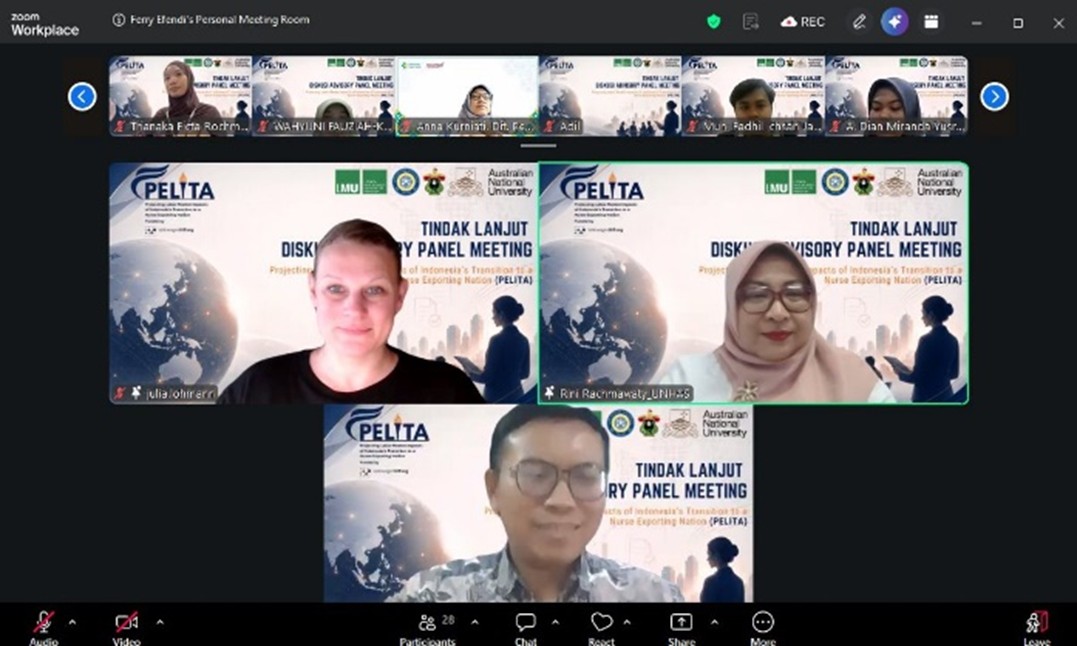
PELITA RESEARCH TEAM: Prof. Dr. Julia Lohmann (LMU Munich, Germany), Prof. Ferry Efendi, S.Kep.Ns., M.Sc., Ph.D (Universitas Airlangga, Indonesia), Prof. Rini Rachmawaty, S.Kep., Ns., M.N., Ph.D (Universitas Hasanuddin, Indonesia)
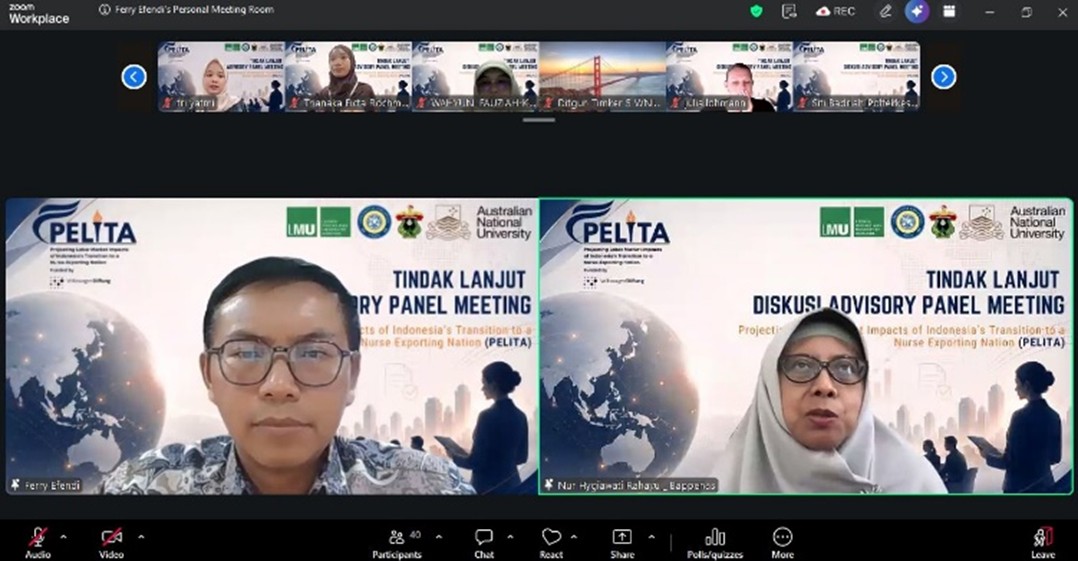
Prof. Ferry and Dr. Nur Hygiawati Rahayu, S.T., M.Sc. (Bappenas), during a consultation session, offering constructive input and recommendations to strengthen the PELITA Project framework.
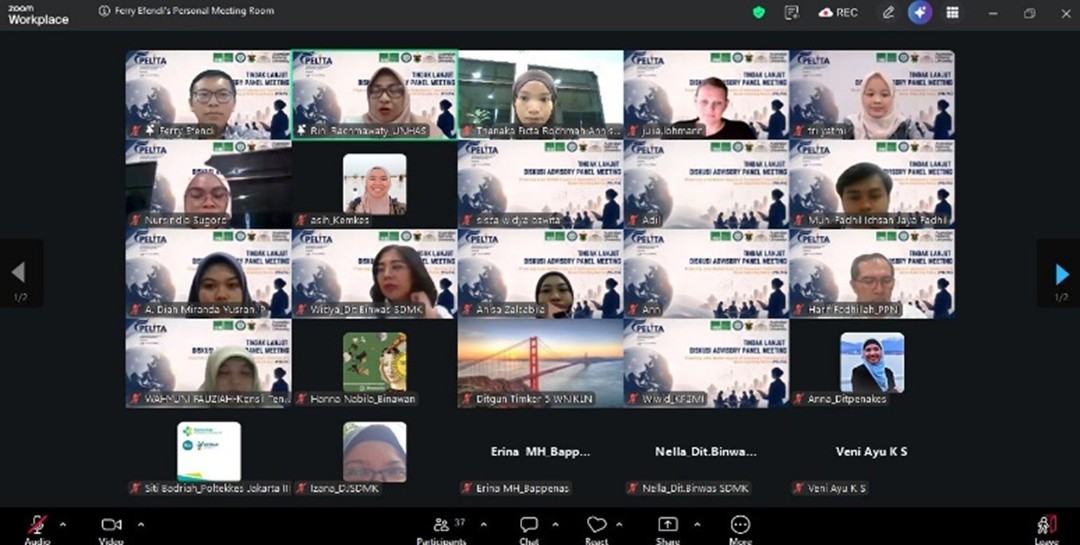
A collage of participants during the Zoom Meeting
Indonesia’s growing role in the global nursing workforce took an important step forward as the PELITA Project convened a Follow-up Advisory Panel Meeting on May 11, 2026, bringing together policymakers, professional associations, migration experts, industry partners, and researchers to collectively rethink how the country prepares nurses for international employment. Held online via Zoom Workplace, the one-hour consultation attracted 39 participants from ministries, agencies, universities, and professional organizations, also our research team, reflecting growing national attention to the long-term consequences of nurse migration for Indonesia’s health system, education sector, and labour market.
The PELITA Project is led by an international and interdisciplinary research team comprising Prof. Dr. Julia Lohmann (LMU Munich, Germany), Prof. Ferry Efendi, S.Kep.Ns., M.Sc., Ph.D (Universitas Airlangga, Indonesia), Prof. Rini Rachmawaty, S.Kep., Ns., M.N., Ph.D (Universitas Hasanuddin, Indonesia), and Prof. Firman Witoelar (Australian National University, Australia), with funding support from the Volkswagen Foundation, Germany.
The meeting was opened by Prof. Rini Rachmawaty, S.Kep., Ns., M.N., Ph.D, from Universitas Hasanuddin, who emphasized the importance of collaboration between researchers and stakeholders in shaping evidence-informed policy for Indonesia’s nursing workforce. In her welcoming remarks, Prof. Dr. Julia Lohmann thanked participants for contributing their expertise despite busy schedules and highlighted the broader objective of the study, “Understanding the Education and Labor Market Consequences of Indonesia’s Push to Become the World’s Leading Nurse Exporting Nation.” She explained that the project explores how nurse migration policies may shape nursing education and workforce transitions in Indonesia. “This is a very good time to involve you to help us prioritize which aspects we should focus on,” she noted as the project moves toward data collection.
The substantive session was facilitated by Prof. Ferry Efendi, S.Kep.Ns., M.Sc., Ph.D, from Universitas Airlangga, who presented updates following the project’s kick-off meeting. Using the Health Labour Market Analysis (HLMA) framework, the team shared revisions to the conceptual model and invited stakeholders to provide feedback on priority research areas, including student motivation and characteristics, educational preparedness, competency development, and labour market opportunities for nurses pursuing international careers.
During the discussion, stakeholders delivered substantive recommendations to strengthen the research framework. Representatives from Bappenas stressed that nurse migration should be examined through three interconnected dimensions: workforce supply, labour market dynamics, and ecosystem readiness. “The ecosystem strongly influences decisions before and after employment,” she explained, highlighting the importance of competency standards, certification, labour market information, and socio-cultural dimensions, including migrant family background and brain drain–brain gain dynamics.
The Indonesian Health Council (KKI) representative emphasized the importance of aligning competency standards with destination countries through Mutual Recognition Agreements (MRA) and stronger preparation for overseas work environments. Drawing from her own experience in Japan, she noted that many challenges abroad stem not from inadequate competence, but from difficulties adapting to advanced healthcare technologies and workplace systems. “The challenge is not competency alone, but how to adjust to healthcare facilities and digital technologies that are far more advanced in destination countries,” she noted.
A delegate from Binawan described the conceptual framework as already appropriate “from upstream to downstream,” while suggesting simplification of specialization-related variables to better reflect employment realities and workplace preferences. Meanwhile, PPNI representative stressed the need to explicitly include credentialing between graduation and labour market entry. “After graduation, there should be a credentialing stage before entering the labour market,” he emphasized, adding that understanding employment contracts is equally important to strengthen worker protection abroad. “The beginning of protection is understanding the contract, so nurses are not disadvantaged,” he added.
From the Directorate of Health Human Resources Utilization, highlighted that the migration pathway should move beyond a “one-way” process focused solely on overseas placement. “This should not be a one-way process, but rather a cyclical process,” she remarked, stressing the importance of return migration, brain gain, and long-term benefits for Indonesia. Complementing this perspective, an expert from the Directorate of Health Human Resources Development and Supervision, emphasized that worker protection systems should become a clearer part of the framework to ensure Indonesian nurses remain safe and supported abroad.
Additional recommendations focused on migrant nurse preparedness. From the Directorate of Health Human Resources Provision, highlighted the importance of clinical experience, institutional capacity, and financing readiness in preparing migrant nurses. Meanwhile, a representative from the Ministry for the Protection of Indonesian Migrant Workers (KP2MI), stressed the importance of psychological readiness and early literacy regarding regulations and workplace environments abroad, noting that Indonesian migrant workers often require six to nine months to adapt overseas.
Closing the meeting, the PELITA research team reaffirmed its commitment to refining the conceptual framework and continuing stakeholder consultations to ensure that the project produces evidence-informed recommendations for Indonesia’s future nursing workforce governance. In her closing remarks, Prof. Rini thanked participants for their comprehensive insights, emphasizing that the discussion had helped sharpen priorities for the next phase of survey development and research planning.